
Link building platforms have matured fast. In 2026, the winning approach is less about “getting a link” and more about placing credible content on sites where it genuinely belongs — with transparent metrics, clear editorial rules, and a footprint that won’t collapse the moment search quality systems tighten. That shift is driven by two forces: (1) search engines getting better at identifying manipulative patterns, and (2) marketers needing scalable workflows that don’t rely on endless cold outreach.
This ranking focuses on marketplace-style platforms (not traditional agencies) where advertisers can source guest posts, link insertions, sponsored articles, or PR-style placements. It also highlights what to watch out for: disclosure rules, publisher quality, and operational details that affect outcomes in Search Engine Optimization (SEO) campaigns.

How this ranking was built
All platforms below are active websites that offer a self-serve marketplace (or a marketplace plus managed support) for acquiring placements. The list is ranked using the same practical criteria a growth team would use when choosing between link building platforms:
- Inventory quality & relevance: how well you can match niche, language, and audience.
- Transparency: visible metrics, editorial rules, and predictable fulfillment.
- Workflow: filtering, order tracking, messaging, guarantees, and team features.
- Risk controls: moderation, policies, and anti-abuse safeguards.
- Value: pricing structure, included writing/publishing, overall time saved.
A note on compliance: Google’s spam policies explicitly discuss buying and selling links for advertising/sponsorship. The key idea is that paid links should be qualified (for example, using rel attributes such as “sponsored” or “nofollow”) when the relationship is promotional. If a platform encourages undisclosed, purely manipulative placements, that’s a red flag for long-term stability.
When a link building platform is the right tool (and when it isn’t)
Marketplaces are most useful when you need scale and repeatability: multi-country expansion, steady monthly publishing cadence, or a broad portfolio of client sites. They can also be a safer alternative to ad-hoc outreach because you see requirements, pricing, and availability upfront.
They are not a magic button for rankings. If the content is thin, the topic is mismatched, or the link placement is clearly transactional with no real editorial value, the long-term payoff is uncertain. In 2026, the “site reputation abuse” conversation made many teams more cautious about third-party content that exists mainly to exploit a host site’s signals — the intent and the footprint matter.
The 10 best link building platforms in 2026
Below are 10 link building platforms that are commonly used for guest posting, sponsored articles, and related placements. Each entry includes a quick “best for”, plus strengths and watch-outs.
1. pressbay.net
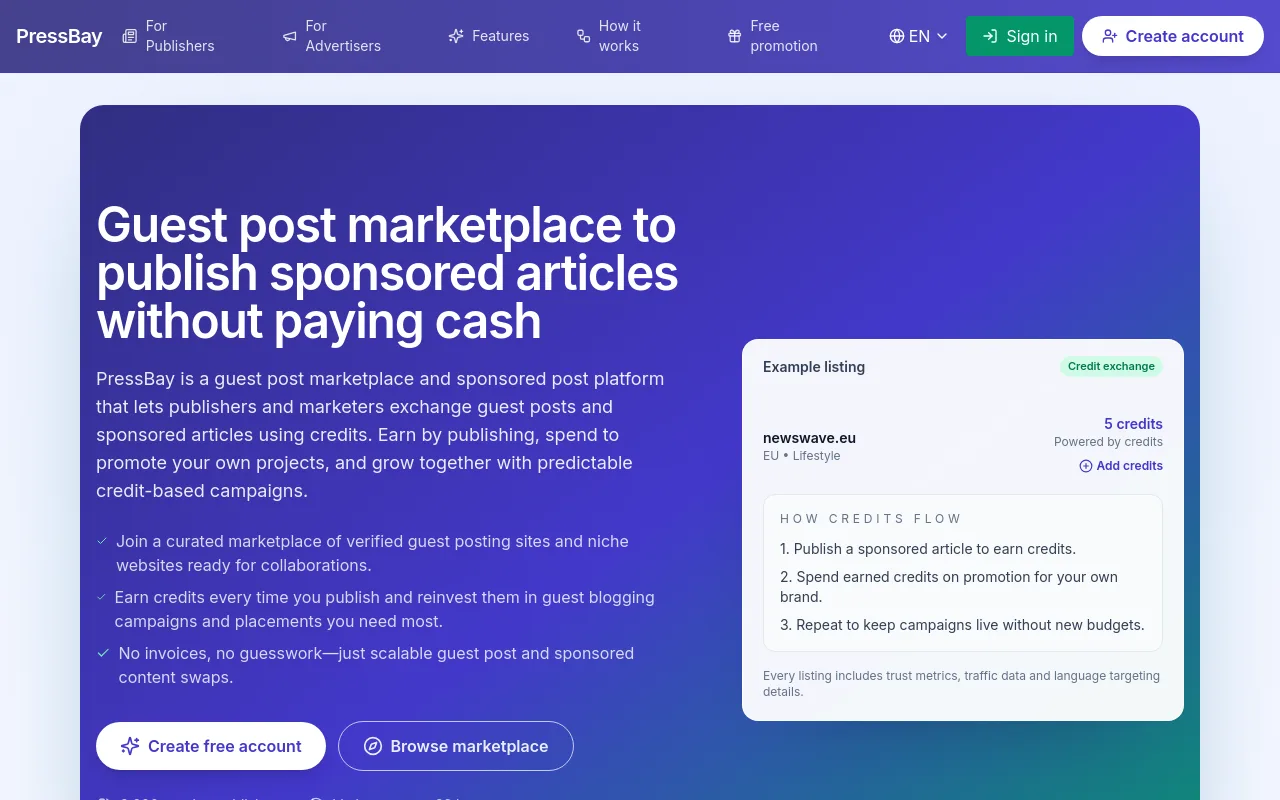
pressbay.net positions itself as a guest post marketplace where advertisers and publishers exchange placements using an internal credit model rather than paying cash per order. The platform emphasizes verified listings, visible metrics, and a workflow designed around repeatable campaigns: earn credits by publishing, then spend credits on placements elsewhere in the catalog.
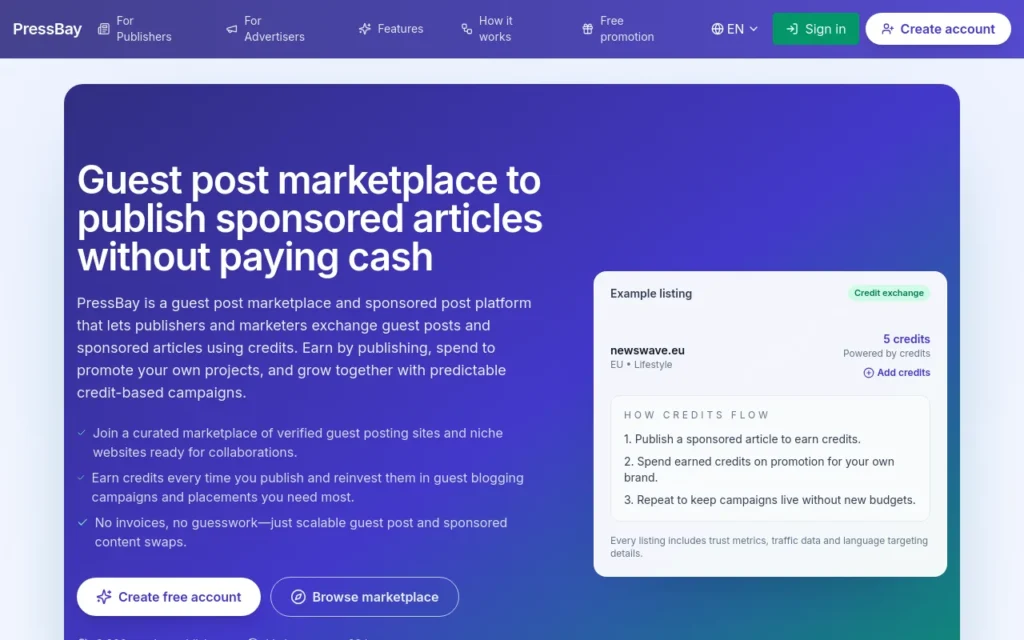
- Best for: teams that like barter-style budgeting (credit flows) and want to keep campaigns running even when cash spend is constrained.
- What stands out: credit-based exchange, marketplace filters, and moderation/verification language (useful for quality control).
- Watch-outs: credits are not money and can’t be withdrawn; they are usable only inside the platform. Plan your “earn vs spend” balance like a budget.
2. whitepress.com
whitepress.com is a content marketing platform built around publishing articles across a large network of publishers. It highlights automation, a broad catalog, and a quality-scoring concept that is checked and assessed by its team (useful when you want an extra layer of curation beyond pure self-serve listings).
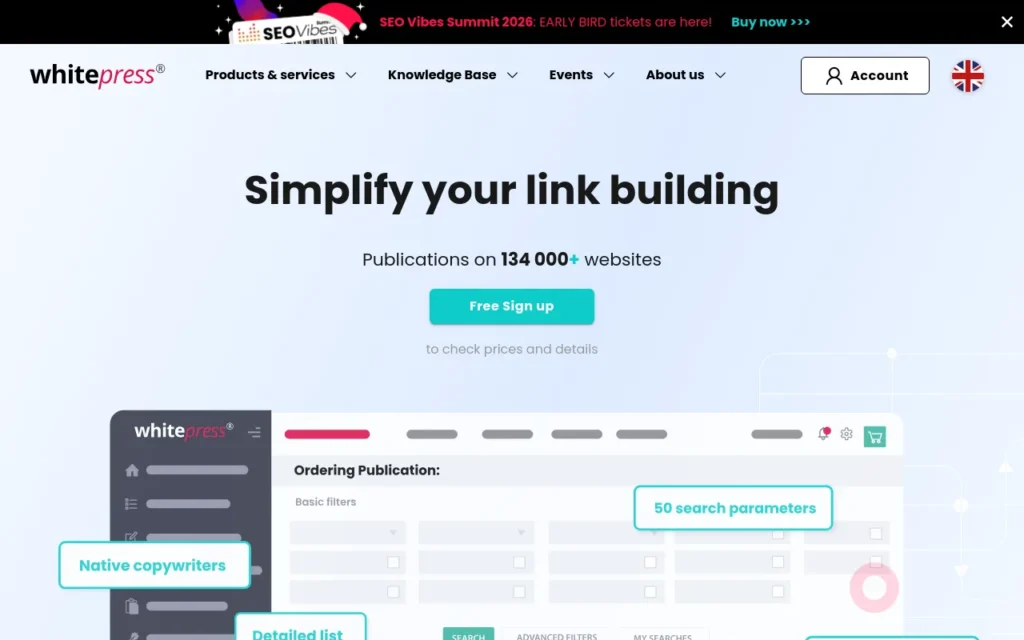
- Best for: brands and agencies who want a mature interface, international publisher access, and optional copywriting baked into the workflow.
- What stands out: platform-led quality scoring and “thousands of portals worldwide” positioning.
- Watch-outs: as with any large catalog, outcomes depend on your selection discipline — match topic, audience, and editorial fit rather than buying on metrics alone.
3. linkhouse.net
Linkhouse describes itself as a link building and content marketing platform with a marketplace workflow: finding offers, managing orders, and monitoring placements. It’s positioned for teams that want structure (projects, ordering, support) while still using a marketplace-style catalog.
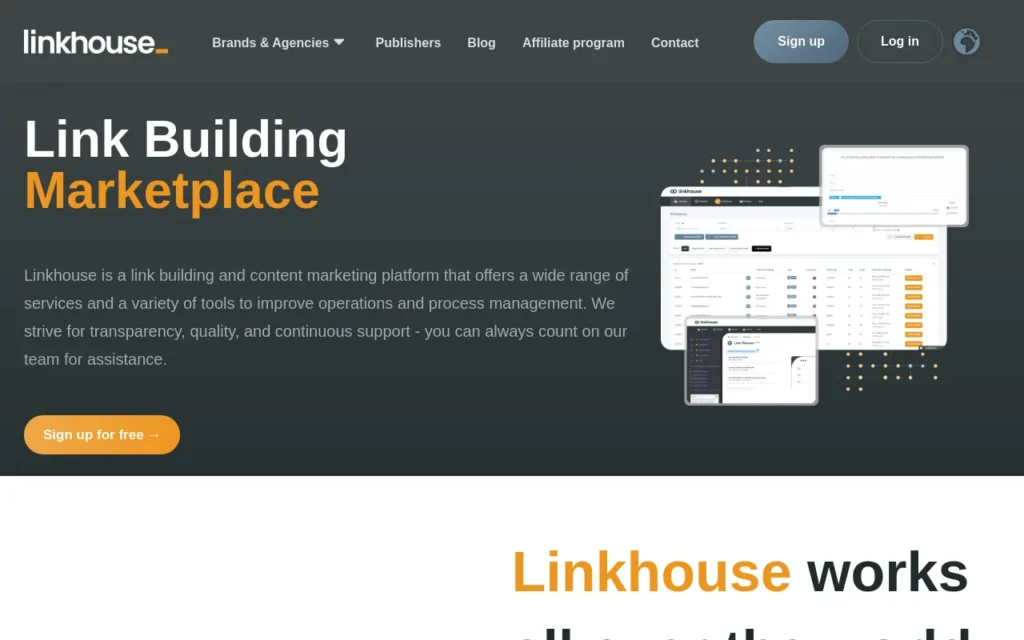
- Best for: marketers who want a dedicated link-building marketplace plus process tooling (order management, support, demos).
- What stands out: explicit positioning around simplifying the end-to-end workflow, and operating globally.
- Watch-outs: treat “database size” as a starting point, not a guarantee — build shortlists by topic fit and publication behavior.
4. insert.link
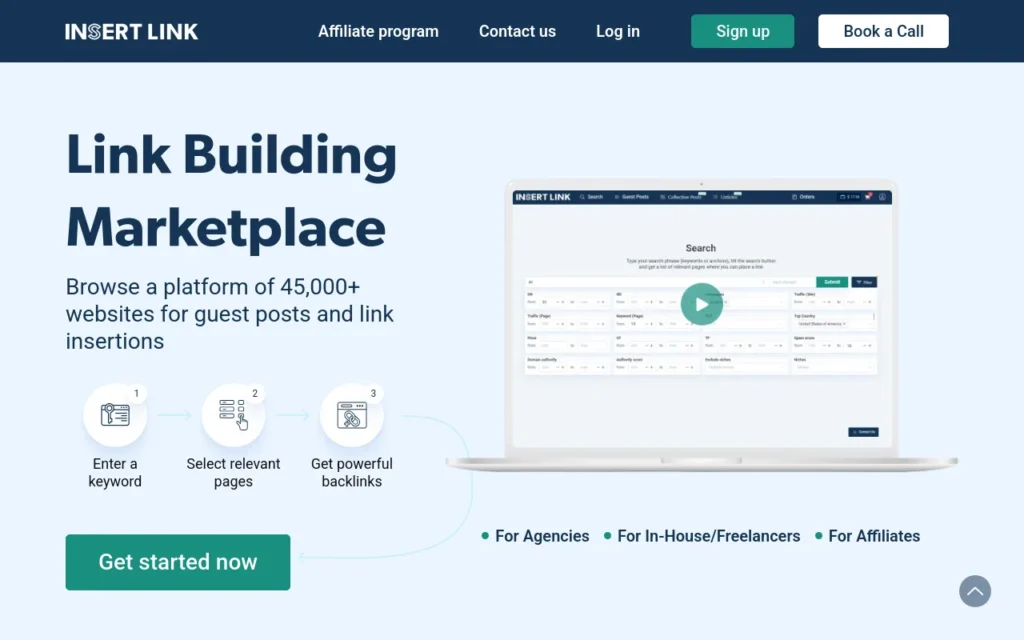
INSERT.LINK is a marketplace centered on link insertion (also known as niche edits/curated links): adding a backlink into an existing article rather than publishing a new guest post. The platform explains the method directly and leans into fast workflow plus agency features like white-label services and reporting.
- Best for: teams running many client sites who prefer niche edits for speed, and want white-label delivery features.
- What stands out: strong focus on link insertions and agency operations (reporting, invoicing, balances).
- Watch-outs: niche edits can create footprint risk if the same “insert pattern” repeats across unrelated sites; vary anchors, topics, and placement types.
5. bazoom.com
Bazoom presents itself as a full-service link building platform with a marketplace angle and a pricing model that emphasizes paying for links without subscription or entry fees, with content and publication included in pricing. This can be attractive if you want a simple “per placement” structure without long-term contracts.
- Best for: buyers who want bundled content + publication pricing and minimal platform overhead.
- What stands out: “no subscription” framing and an integrated approach to content + placement.
- Watch-outs: bundled writing is convenient, but editorial fit still matters — ask for topic outlines and adjust to match publisher style.
6. collaborator.pro
Collaborator operates as a marketplace for advertising and guest posts, including a large catalog. It also highlights third-party badges/awards on its site, which may matter for teams that want social proof when picking a vendor category.
- Best for: teams that want a broad catalog and a platform that explicitly positions itself around SEO, content marketing, and PR use cases.
- What stands out: scale messaging and multi-language orientation.
- Watch-outs: large catalogs can include mixed quality; enforce your own minimums (topic relevance, traffic sanity checks, and editorial standards).
7. prnews.io
PRNEWS.IO is positioned as a sponsored content marketplace geared toward media placements. Its core promise is simple ordering: pick a publisher, submit text, get published — with messaging around accessing a very large catalog of outlets and automation that removes the back-and-forth of editor outreach.
- Best for: brands that want PR-style placements and reputation-oriented coverage alongside SEO value.
- What stands out: strong focus on “sponsored media placements” and fast, structured ordering.
- Watch-outs: not every media placement is a “ranking link”; define the goal (brand mentions, referral traffic, entity signals) before choosing outlets.
8. linkpublishers.com
Link Publishers positions itself as a link building platform and guest post marketplace with multiple service lines (guest posting, niche edits, and digital PR). It also highlights guarantees (live link or replacement/money-back language) and integrations with common SEO tool ecosystems.
- Best for: teams that want a marketplace plus optional add-ons (writing, digital PR-style services) and clear guarantee language.
- What stands out: multi-service menu and “marketplace + guarantee” positioning.
- Watch-outs: whenever a platform offers many service types, keep your campaign design tight — don’t mix tactics that create an obvious footprint in one quarter.
9. adsy.com
Adsy markets itself as a blog posting service with a large inventory and a process designed to help advertisers submit content and secure placements. It emphasizes volume (unique websites) and a “secure blog posting process” style of workflow.
- Best for: advertisers who value a straightforward buying flow and broad inventory, especially when you need many placements across categories.
- What stands out: scale messaging and a guided “get started” approach.
- Watch-outs: with high-volume platforms, selection discipline is everything — build a strict checklist for topical fit and editorial quality.
10. accessily.com
Accessily positions itself as “all your link building in one platform” and frames its offering as a control panel for professional SEO execution, including campaign strategy, negotiation, and post-publish tracking. That framing can appeal to teams who want more than a simple “order and forget” marketplace.
- Best for: teams who want campaign structure and tracking as part of the marketplace experience (not just a list of sites).
- What stands out: operational framing — execution workflow and post-publish tracking emphasis.
- Watch-outs: tracking is only useful if your KPIs are defined (rank movement, qualified traffic, conversions, or brand visibility). Decide before buying.
Three marketplace archetypes (so you pick faster)
Not all link building platforms behave the same, even if they all sell “placements”. In practice, most marketplaces fall into three archetypes, and knowing which one you’re buying from helps you set expectations.
- Guest post marketplaces: you publish a new article on a partner site, usually with one or more contextual links. This is the best fit when you want topical authority signals and a narrative that supports the link. These platforms often include writer options, editorial guidelines, and publication timelines.
- Niche edit / link insertion marketplaces: instead of publishing a new post, you insert a link into an existing page. This can be faster, but it demands stricter quality control: the existing page must be relevant, indexed, and stable, and the insertion should look natural in context.
- Sponsored media placement marketplaces: you buy a placement that looks more like PR distribution than classic guest posting. The “win” here can be brand visibility, entity reinforcement, referral traffic, and credibility — links may be present, but the primary value is often coverage and trust.
A practical budgeting tip: allocate your first month by outcomes rather than by platform. For example, reserve a portion for relevance-first guest posts (authority building), a portion for niche edits (speed and internal-page support), and a portion for PR-style placements (brand and trust). Then review performance after 30–60 days and shift budget only toward the tactics that show measurable movement (rankings, qualified traffic, or conversions).

Practical selection checklist for 2026 campaigns
Choosing between link building platforms is less about the platform name and more about whether its workflows help you stay within a safe, credible publishing pattern. Use this checklist before you buy:
- Start with relevance, not metrics: pick sites where the topic match is obvious to a human reader, and where the article would make sense even without the link.
- Ask how the link is treated: for sponsored relationships, qualifying links is part of policy guidance. If a publisher refuses any disclosure or tries to “guarantee dofollow forever”, treat it as risk.
- Check publication persistence: marketplaces often set minimum live periods. Make sure that matches your expectations for link longevity.
- Vary formats: mix guest posts, link insertions, and PR-style placements to avoid repetitive footprints across domains.
- Stagger velocity: plan a publishing cadence that looks natural for your site’s size and growth stage.
- Measure beyond rankings: track referral traffic, assisted conversions, and brand mentions — not just keyword positions.
Common mistakes that still sink marketplace link building
Even with good tools, the same mistakes repeat:
- Buying on DR/DA alone: high metric sites can still be off-topic, overloaded with sponsored content, or inconsistent in editorial standards.
- Overusing the same anchors: repeating “money anchors” across many placements is one of the easiest footprints to spot.
- Publishing “parasite-style” third-party content: if content exists only to exploit a host’s reputation signals, it can fall into policy enforcement risk.
- Ignoring disclosure realities: many legitimate publishers will mark sponsored relationships. Plan for that; don’t build a strategy that requires every link to pass full equity.
Final takeaway
The best link building platforms in 2026 are the ones that make it easier to act like a real publisher: choose relevant sites, publish content that deserves to exist, and keep your footprint diversified. Start with a small pilot (5–10 placements), document what “good” looks like for your niche, then scale only what produces stable results.